Showing posts with label Mauritius. Show all posts

Friday, 20 February 2015

Jardin de Pamplemousses , Mauritius

The Sir Seewoosagur Ramgoolam Botanical Garden (sometimes shortened to the SSR Botanical Garden), commonly known as the Pamplemousses Botanical Garden, is a popular tourist attraction in Pamplemousses, near Port Louis, Mauritius, and the oldest botanical garden in the Southern Hemisphere. Famous for its long pond of giant water lilies (Victoria amazonica), the garden was first constructed by Pierre Poivre (1719 – 1786) in 1770, and it covers an area of around 37 hectares.

The garden, for a long time was ranked third among all the gardens that could be admired over the surface of the globe’, have been known successively as ‘Jardin de Mon Plaisir’, ‘Jardin des Plantes’, ‘Le Jardin National de l’Ile de France’, ‘Jardin Royal’, ‘Jardin Botanique des Pamplemousses’, and during the British colonisation, ‘The Royal Botanical Gardens of Pamplemousses’ and ‘The Royal Botanic Gardens, Pamplemousses’. On 17 September 1988 the garden was formally named “Sir Seewoosagur Ramgoolam Botanic Garden”, named after the first prime minister of Mauritius, as was the smaller SSR Botanical Garden of Curepipe..

Big thanks to Angela for this postcard!
Sent: 11 November 2014   Received: 25 November 2014   Travelled: 14 days

Dodo bird


As no complete dodo specimens exist, its external appearance, such as plumage and colouration, is hard to determine.Illustrations and written accounts of encounters with the dodo between its discovery and its extinction (1598–1662) are the primary evidence for its external appearance. According to most representations, the dodo had greyish or brownish plumage, with lighter primary feathers and a tuft of curly light feathers high on its rear end. The head was grey and naked, the beak green, black and yellow, and the legs were stout and yellowish, with black claws. The bird was sexually dimorphic: males were larger and had proportionally longer beaks. The beak was up to 23 centimetres (9.1 in) in length and had a hooked point

Yay another dodo bird postcard, a huge surprise in my mailbox when I received
6 postcards individually stamped and written, a parting gift from Angela's time 
in Mauritius.
Sent: 11 November 2014   Received: 25 November 2014   Travelled: 14 days

Map of Mauritius


Map of Mauritius with it's various attractions, thank you Angela!
Sent: 11 November 2014   Received: 25 November 2014   Travelled: 14 days

Mauritian Saga


The pic on the left is of a girl dancing the traditional dance
called "Saga". Thank you Angela for this beautiful card of
a native girl.

Sent: 11 November 2014   Received: 25 November 2014   Travelled: 14 days

Ganga Talao, Mauritius

Ganga Talao  is a crater lake situated in a secluded mountain area in the district of Savanne, deep in the heart of Mauritius. It is about 1800 feet above sea level. The first group of pilgrims who went to Ganga Talao were from the village of Triolet and it was led by Pandit Giri Gossayne from Terre Rouge in 1898.
There is a temple dedicated to Lord Shiva and other Gods including Hanuman, Lakshmi, and others along the Grand Bassin. During Shivaratri, many pilgrims in Mauritius walk bare feet from their homes to the lake. It is considered the most sacred Hindu place in Mauritius.

Another beautiful card sent by Angela
Sent: 11 November 2014   Received: 25 November2014    Travelled: 14 days

Curepipe, Mauritius

The town's name, Curepipe, is said to be originated from the French curer sa pipe, which translates to "cleaning the pipe". There are several theories by historians as to the naming of the city. Some historians believe that the name was given as travelers and soldiers from the 19th century, traveled from Port Louis and Grand Port (now Mahébourg) to refill their pipes in Curepipe. Other historians believe that the name was given after a late landowner during the 18th century.

Sent by Angela 11 November 2014   Received: 25 November 2014   Travelled: 14 days

Thursday, 1 January 2015

Mauritius map

Wow this wonderful map card is sent by my Singaporean 
friend Angela, who was posted here for a project. From her, I found that
there are actually cheap flights from Kuala Lumpur direct to Mauritius
by Air Mauritius. Interesting....
Received: 1 October 2014

Thursday, 23 January 2014

The dodo


The first recorded mention of the Dodo was by Dutch sailors in 1598. In the following years, the bird was hunted by sailors, their domesticated animals, and invasive species introduced during that time. The last widely accepted sighting of a Dodo was in 1662. Its extinction was not immediately noticed, and some considered it to be a mythical creature. In the 19th century, research was conducted on a small quantity of remains of four specimens that had been brought to Europe in the early 17th century. Among these is a dried head, the only soft tissue of the Dodo that remains today. Since then, a large amount of subfossil material has been collected from Mauritius, mostly from the Mare aux Songes swamp. The extinction of the Dodo within less than a century of its discovery called attention to the previously unrecognised problem of human involvement in the disappearance of entire species. The Dodo achieved widespread recognition from its role in the story of Alice in Wonderland, and it has since become a fixture in popular culture, often as a symbol of extinction and obsolescence. It is frequently used as a mascot on Mauritius.

The first time I read about the dodo, I was a small kid reading children's encyclopedia. I get sad about the disappearance of a harmless bird and how an entire species can be gone within a century. People back then didn't know about their impact on the ecosystem and even to this day, locals in remote areas hunt wildlife for their living. People's needs will always trump the animals right to land.
Thank you Tasneem for this wonderful card of the dodo!

Sent: 13 January 2014
Received: 23 January 2014
Travelling: 10 days

Yay a dodo bird


The first Portuguese explorers found no indigenous people living on the island in 1507. The Dutch settled on the island in 1638 and abandoned it in 1710. Five years later, the island became a French colony and was renamed Isle de France. The British took control of Mauritius in 1810 during the Napoleonic Wars. The country remained under British rule until it became an independent Commonwealth realm on 12 March 1968 and a republic within the Commonwealth on 12 March 1992.
The country is multi-ethnic and multi-cultural; most Mauritians are multilingual, and English, French, Creole and Asian languages are used.The government system is closely modelled on the Westminster parliamentary system. Mauritius is highly ranked for democracy and for economic and political freedom.
The island of Mauritius was the only home of the Dodo bird. The bird became extinct fewer than eighty years after its discovery.
 Thank you Tasneem for this amazing card!
 
Sent: 13 January 2014,   Received: 23 January 2014,   Travelled: 10 days

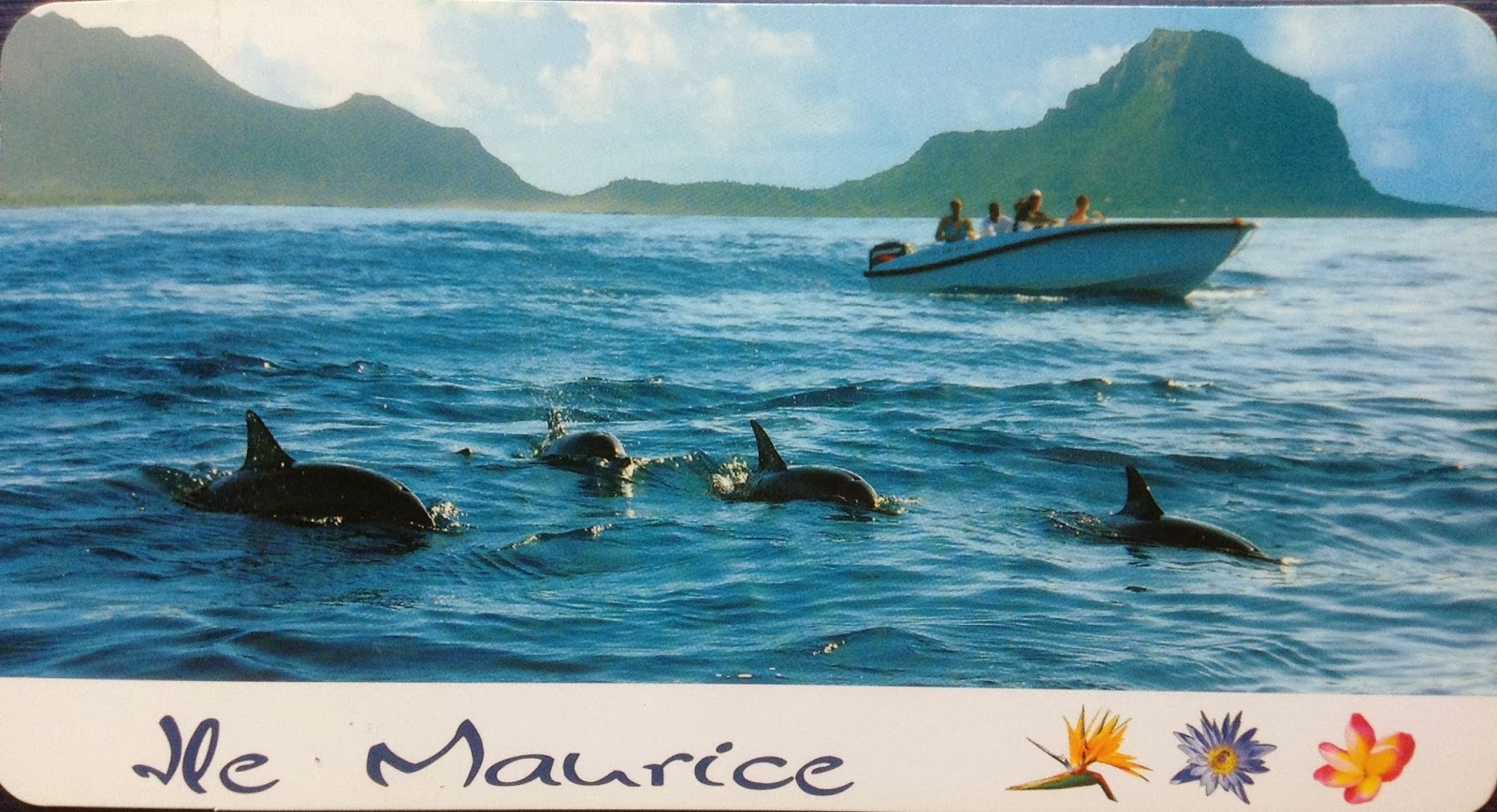
Dolphins in Mauritius


On Mauritius west coast you have the unique opportunity to watch dolphins frolicking in the water. The skipper of the speedboat will take you to the place where you can watch the dolphins. You will even have the chance to swim with them and watch them at first hand in their natural environment so do not forget to take your snorkel, fin and mask. On a lucky day you can find yourself in a group of 20-30 dolphins at one time. The mother dolphins with their babies are very special and impressive to watch. If you listen carefully you can hear the dolphins ‘singing’ under the water!
Some companies only want to earn money with these dolphin trips and they chase them in order to get close to them. Living under such a stress factor, the dolphins will sooner or later find another place to rest.

I want to see dolphins in the sea! We sometimes have dolphins near our islands but you can only catch them early in the morning around 5-6am. The thing about animal tours is that tourists sometimes forget that in having a close encounter with wildlife it can stress the animals or harm them. That's why one should do research on the tour activity to make sure that it doesn't cause harm.
Thank you Tasneem for this lovely dolphin card!

Sent: 13 January 2014   Received: 23 January 2014   Travelled: 10 days (wow!)