Showing posts with label Penguins. Show all posts

Saturday, 28 May 2016

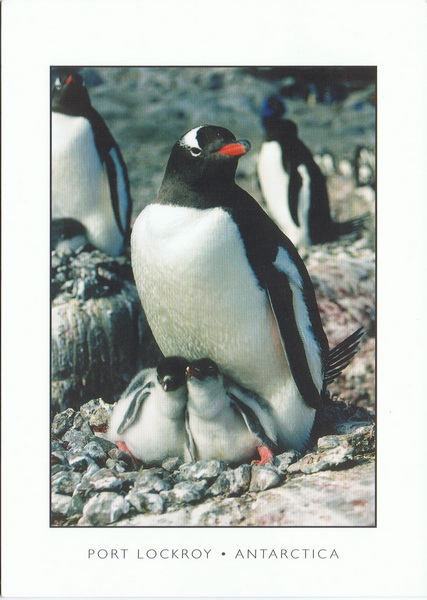
Antartica


Boo! back again from my short hiatus, have been watching a Chinese historical
drama and sometimes my eyes feel too strained to continue working on the laptop
after work. Now I'm back to my original intent which was to blog the postcards from
2014. Antartica came as a huge surprise from Ruben who sends this via
the United Kingdom Antartic Heritage Trust,UKAHT. Thank you very much Ruben
In fact I totally forgot about this card until I went through the box hiding my 2014 cards,
so I was even more amazed that I have an Antartica card sent from Port Lockroy. I have
a few other Antartica cards sent from NZ base, French Antartica and the USA
Fort McMurdo :D Thanks so much Ruben!
Sent: 12 November 2014   Received: 16 Dec 2014 Travelled: 34 days

Monday, 28 March 2016

Magellanic Penguin


The Magellanic penguin (Spheniscus magellanicus) is a South American penguin, breeding in coastal Argentina, Chile and the Falkland Islands, with some migrating to Brazil where they are occasionally seen as far north as Rio de Janeiro. It is the most numerous of the Spheniscus penguins. Its nearest relatives are the African, the Humboldt penguin and the Galápagos penguins. The Magellanic penguin was named after Portuguese explorer Ferdinand Magellan, who spotted the birds in 1520. The species is listed as Near Threatened by the IUCN.
Source: Wikipedia
YAY! My Penguin card arrived at last! I thought it was lost as I sent 
home two cards from Ushuaia and the other card arrived two weeks earlier.
The first card was of People and for my second card I chose Penguins, if you realised by
now, both are locals of the region ;) Unfortunately I couldn't get different stamps as
the Post Office was closed on the weekend but at least I didn't get charged extra when
buying stamps from the souvenir shop.
Sent: 20 January 2016   Received: 17 March 2016   Travelled: 57 days

Saturday, 19 March 2016

Adélie penguin


The coast of Adélie Land was discovered in 1840 by the French explorer Jules Dumont d'Urville (1790 – 1842) who named it after his wife, Adèle. This is the basis of the French claim on this Antarctic land. The Dumont d'Urville research station was the filming location of the documentary March of the Penguins (2005).

The Adélie penguin (Pygoscelis adeliae) is a species of penguin common along the entire Antarctic coast, which is their only residence. They are among the most southerly distributed of all seabirds, along with the emperor penguin, the south polar skua, the Wilson's storm petrel, the snow petrel, and the Antarctic petrel. They are named after Adélie Land, in turn named for the wife of French explorer Jules Dumont d'Urville who discovered these penguins in 1840.
Source: Wikipedia
Penguins from Antartica!
Sent: 1 January 2016   Received: 25 February 2016   Travelled: 56 days

Saturday, 28 February 2015

Fauna of Patagonia

Bird-life is often abundant. The southern caracara (Caracara plancus) is one of the characteristic objects of a Patagonian landscape; the presence of austral parakeets (Enicognathus ferrugineus) as far south as the shores of the strait attracted the attention of the earlier navigators; and green-backed firecrowns (Sephanoides sephaniodes), a species of hummingbird, may be seen flying amidst the falling snow. Of the many kinds of waterfowl it is enough to mention the Chilean flamingo (Phoenicopterus chilensis), the upland goose (Chloephaga picta), and in the strait the remarkable steamer ducks.

Signature marine fauna include the southern right whale, the Magellanic penguin (Spheniscus magellanicus), the orca and elephant seals. The Valdés Peninsula is a UNESCO World Heritage Site for its importance as a nature reserve.
Thanks to Mariana for this nice postcard
Sent:3 May 2013    Received: 5 June 2013   Travelled: 34 days

Friday, 20 June 2014

Tristan da Cunha

 
Tristan da Cunha colloquially Tristan, is both a remote group of volcanic islands in the south Atlantic Ocean and the main island of that group. It is the most remote inhabited archipelago in the world, lying 2,000 kilometres (1,243 mi) from nearest inhabited land, Saint Helena, 2,400 kilometres (1,491 mi) from the nearest continental land, South Africa, and 3,360 kilometres (2,088 mi) from South America. The territory consists of the main island, also named Tristan da Cunha, along with the smaller, uninhabited Nightingale Islands and the wildlife reserves of Inaccessible and Gough Islands.
Tristan da Cunha is part of the British overseas territory of Saint Helena, Ascension and Tristan da Cunha. The island has a permanent population of 275.
The islands were first sighted in 1506 by Portuguese explorer Tristão da Cunha, although rough seas prevented a landing. He named the main island after himself, Ilha de Tristão da Cunha, which was anglicised from its earliest mention on British Admiralty charts to Tristan da Cunha Island.
 
@.@!!! I'm already blank in thoughts after receiving such great cards
from Belize, Peru and now this! A new country addition to my collection
from one of the remotest places in the world. I also find it rather funny
to receive the Rockhopper penguins (do they walk funny? or is it their stylish crest?!)
because I always think that black and white animals such as Dalmatians, Hertfordshire cows,
pandas , zebras and such are Mother Nature's humourous art creations.
AWESOME STAMPS!
mucho gracias Ruben for this absolutely rare gem!
Sent: 28 May 2014   Received: 20 June 2014   Travelled: 23 days
Monday, 9 June 2014

Antartica

Several governments maintain permanent manned research stations on the continent. The number of people conducting and supporting scientific research and other work on the continent and its nearby islands varies from about 1,000 in winter to about 5,000 in the summer, giving it a population density between 0.00007 inhabitants per square kilometre (0.00018 /sq mi) and 0.00035 inhabitants per square kilometre (0.00091 /sq mi) at these times. Many of the stations are staffed year-round, the winter-over personnel typically arriving from their home countries for a one-year assignment. An Orthodox church, Trinity Church, opened in 2004 at the Russian Bellingshausen Station is also manned year-round by one or two priests, who are similarly rotated every year.

AAAAAAAAHHHHHHHH
The biggest surprise in my mailbox yesterday, a Penguin and her egg
all the way from Antartica!!
Special thanks to Starring You for this gem of a postcard!
#135th Country
Received: 9 June 2014

Monday, 25 March 2013

French Southern and Antartic Lands

Thanks to Wenceslas for this fantastic card from T.A.A.F!
Love the stamp and the chop ^.^
Sent: 7 March 2013   Receievd: 25 April 2013    Travelled: 49 days